The hardware
Three modules, one pole, no mystery box.
Spin it, take it apart, and look at what is actually inside. This is the real CAD model, not an illustration.
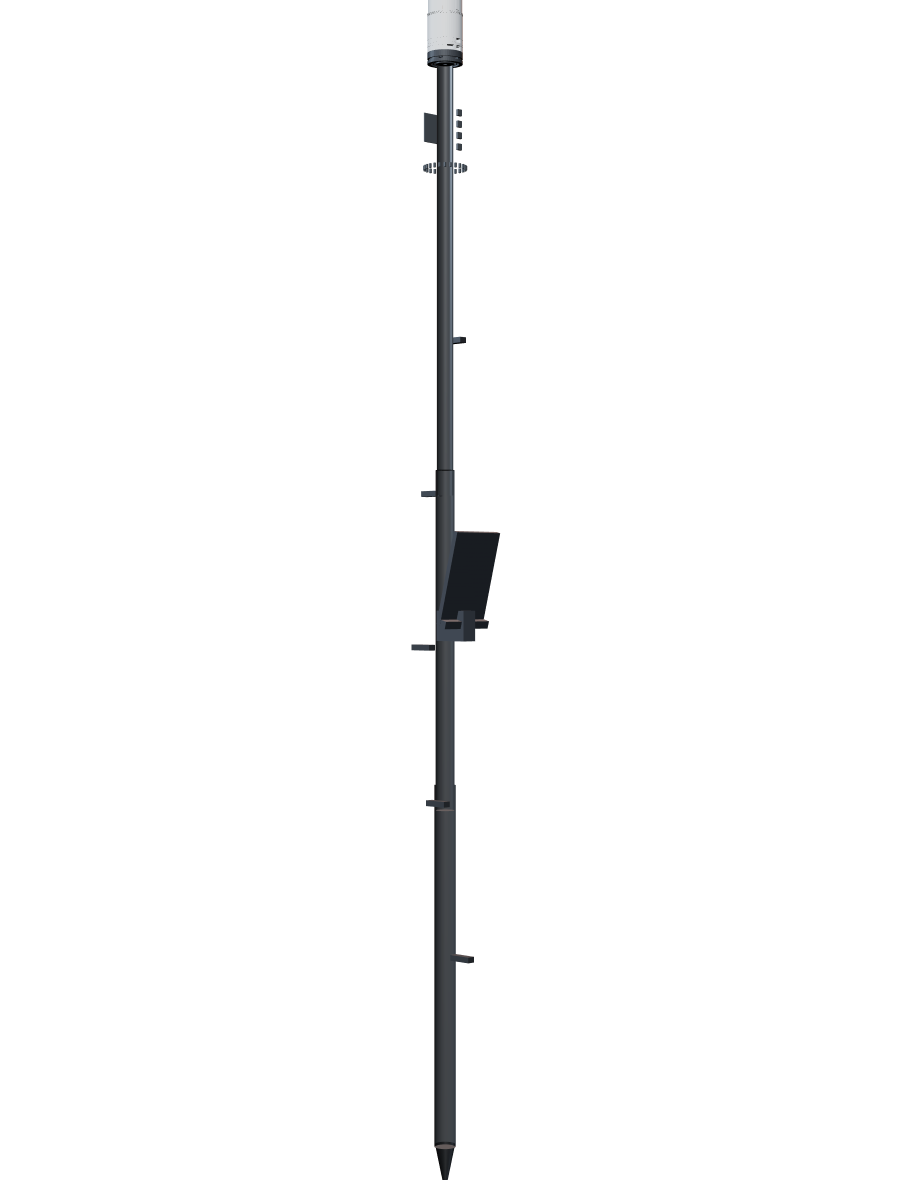
drag to rotate
Look inside
Pick a module and the model will take you to it.
Start anywhere
Choose a module above, or drag the model directly. On the base station the tripod, tribrach and antenna behave the same way.
The 3D model loads only after the page is interactive, and only on devices that can render it — on anything else you get the still image above and nothing is lost.
Rover
Aerom Rover
The unit that walks the site. Two metres extended, collapsing for transport, with the battery as its own swappable module.
- RTK position accuracy
- 0.01 m + 1 ppm CEP
- PPP position accuracy
- 0.10 m CEP
- Navigation update rate
- Up to 25 Hz (RTK)
- RTK convergence
- < 10 sec
- PPP convergence
- < 120 sec
- Cold start
- 27 sec
- Aided / reacquisition start
- 2 sec
- Acquisition sensitivity
- −157 dBm (hot start), −160 dBm (reacquisition)
- Constellations
- GPS, GLONASS-compatible multi-GNSS, Galileo, BeiDou, QZSS, NavIC, SBAS
- Bands
- All major L-band signals across every supported constellation
- Corrections
- NTRIP client and caster, RTCM3 in and out
- Gateway
- Raspberry Pi Zero 2 W — serial to receiver, WebSocket telemetry to the field app
- Anti-jamming
- Continuous-wave interference detection
- Anti-spoofing
- Advanced spoofing-detection algorithms
- Extended height
- 2.00 m to the top of the antenna
- Collapsed length
- Roughly a quarter of extended height, for transport
- Pole
- Telescoping segments with cam-lock collars
- Antenna reference
- Marked ARP datum at the pole top
- Power
- Swappable battery module, 4-segment charge indicator
- Phone mount
- Flat cradle, screen facing the operator, clear of the collars
- Antenna
- Active and passive GNSS antennas supported
- Environmental rating
- Not yet certified — production build
Base station
Aerom Base
Set once, feed the whole crew. The same gateway and battery modules as the rover, on a survey tripod with a tribrach.
- RTK position accuracy
- 0.01 m + 1 ppm CEP
- Navigation update rate
- Up to 25 Hz (RTK)
- Setup
- Over a known point, or averaged in fix
- Raw logging
- Full-session raw observations for PPK
- Constellations
- GPS, GLONASS-compatible multi-GNSS, Galileo, BeiDou, QZSS, NavIC, SBAS
- Corrections out
- RTCM3 over NTRIP, serial or Wi-Fi
- Rovers supported
- Multiple rovers from one base
- Gateway
- Raspberry Pi Zero 2 W, same telemetry stack as the rover
- Antenna
- Ground-plane antenna under a sealed radome
- Mount
- Survey tripod with levelling tribrach and centring plate
- Height
- 1.44 m at working extension
- Power
- Same swappable battery module as the rover
Software
The field app and the desktop companion
Aerom Capture collects in the field; Aerom Studio post-processes back at the office. Same data, same conventions, no manual reformatting between them.
- Platform
- Aerom Capture — Android field app
- Collection
- RTK/PPK point, line, polygon, and surface/road capture with per-point quality
- NTRIP client and caster
- SoI CORS presets, mount-point browser, failover, Aerom Caster publishing
- Stakeout
- Point, line, DTM surface, and road/chainage, with live voice guidance
- COGO tools
- Inverse, traverse, intersection, resection, point averaging
- Coordinate systems
- India CRS catalogue (UTM 42–47N, EPSG:7755), custom Helmert-7, live-telemetry UTM auto-suggest
- Site calibration
- GNSS-to-local control-point fit for localized jobs
- Import / export
- CSV, DXF, KML, Shapefile, PNEZD, GeoJSON, LandXML, RINEX, and a one-page PDF job report
- Platform
- Aerom Studio — Windows desktop post-processor
- Headline workflow
- Kinematic PPK — recovers survey-grade FIX from raw logs when NTRIP drops mid-job
- Static processing
- Precise single-coordinate solve, e.g. establishing a base against a CORS
- Quality readout
- Fix / Float / Single status, AR ratio, % fix, time-to-first-fix, fix-loss timeline
- QA/QC report
- Exportable, defensible PDF with engine version, options, base coordinate, CRS, per-point quality
- CRS / datum
- WGS84, UTM 43N + adjacent zones, EPSG:7755, EGM2008 geoid — never silently switched
- Deliverables
- POS, PNEZD CSV, general CSV, DXF, KML, SHP, GeoJSON, LandXML
Design decisions
Why it is shaped like this
The battery is a module, not a compartment
Putting cells in the pole would have blocked the pole from collapsing. Making the battery its own module solved both problems at once and made hot-swapping possible.
The ARP is physically marked
Antenna height entered wrong is one of the most common ways a survey goes quietly wrong. A marked datum turns a guess into a reading.
The phone sits flat and clear
Mounted in the middle of a segment, away from every cam collar, with the screen square to the operator. Small decision, all day long.
The IMU belongs on the antenna
Tilt compensation only works if the inertial sensor is rigid with the antenna, not with a phone that moves in its cradle. That is why tilt is a roadmap item done properly rather than a shipped item done badly.
Buying & support
What you actually get, and what happens afterwards
The questions that decide a purchase are rarely about accuracy. They are about delivery, warranty and who picks up the phone at 4pm on a Thursday.
In the box
- Aerom rover — receiver, gateway and antenna assembly
- Telescoping survey pole with marked ARP datum
- Swappable battery module
- Charger and cable set
- Flat phone cradle
- Transport case
- Calibration and antenna-offset record for your specific unit
- Lead time
- 4–6 weeks from order during the pilot programme
- Warranty
- 12 months against manufacturing defects
- Service turnaround
- Target 5 working days in-workshop, plus transit
- Support hours
- Monday to Saturday, 9am–7pm IST
- How you reach us
- Phone, WhatsApp and email — to us, not to a dealer
- Training
- Included: a live onboarding session for your crew, plus written and video guides in English and Hindi
Full warranty and service terms come with the quotation. Read them before you buy — from us or from anyone.
FAQ
About the hardware, and about buying it
How tall is the rover?
Two metres fully extended, on a telescoping pole that collapses to roughly a quarter of that for transport. The antenna reference point is marked on the pole so antenna height is a value you read, not a value you estimate.
Why a swappable battery?
Because a sealed battery that dies at 2pm costs you the afternoon. The battery is its own module between the pole and the gateway enclosure, so you carry a spare and change it in the field. It also let us keep the pole free to collapse, which a pole full of cells cannot do.
What is the Raspberry Pi doing in there?
It is the gateway: it reads the receiver over serial, streams telemetry to the field app over WebSocket, and relays RTCM corrections in both directions. Keeping that on a general-purpose computer rather than a fixed microcontroller is what lets the software side move quickly.
Is it weatherproof?
Environmental sealing and an ingress rating are part of the production build, not yet certified. We would rather tell you that than quote an IP number we have not tested to. It is one of the things the pilot programme exists to prove.
Can I use my own antenna or pole?
The pole uses a standard survey thread interface, so yes on the pole. On the antenna, the phase-centre offset is what the accuracy claim depends on, so a swap needs the replacement antenna's characterised offset entered in software. Talk to us before you do it.
What happens if it breaks on site?
You call or WhatsApp us directly — there is no dealer in between, which is the point. Support runs Monday to Saturday, 9am to 7pm IST. If the unit has to come in, we target five working days in the workshop plus transit. During the pilot programme we will also talk to you about a loan unit so a fault does not stop your job; ask us and we will tell you honestly what we can cover at your location.
What warranty do you offer?
Twelve months against manufacturing defects from the date of delivery, covering the receiver, gateway, antenna and battery module. Physical damage, water ingress beyond the rated conditions and unauthorised opening are not covered. Full terms come with the quotation — read them before you buy, from us or from anyone.
How long from order to delivery?
Four to six weeks during the pilot programme. We would rather quote a real date and hit it than quote two weeks and disappoint you. If you have a project deadline, tell us the date when you enquire and we will tell you straight away whether we can meet it.
Who trains my crew?
We do, directly. A live onboarding session for your team is included, plus written and video guides in English and Hindi. For institutional deployments we run a longer session and help you set standard project templates so every crew works to the same configuration.
What if I already use another brand's workflow?
Aerom exports the standard formats — RINEX, CSV, and the CAD and government deliverable formats — so it drops into an existing office workflow rather than replacing it. If your deliverable needs a format we do not yet write, tell us during the pilot; that feedback is exactly what the programme is for.
Can I see one before I commit?
Yes, and you should. We would rather you handled a unit and ran it against a control point you already know the answer to than took our word for anything on this website.
Next step
Want to hold one?
Aerom is in its pilot programme. Tell us what you survey and we will arrange a demonstration and send the full specification and price sheet.
Prefer email? prashantkr2804@gmail.com